
EU AI Office Names Dino Pedreschi Vice-Chair of Working Group 1 for the AI Act Code of Practice
The European Commission published the final version of the Code of Practice on Marking and Labelling of AI-Generated Content on…
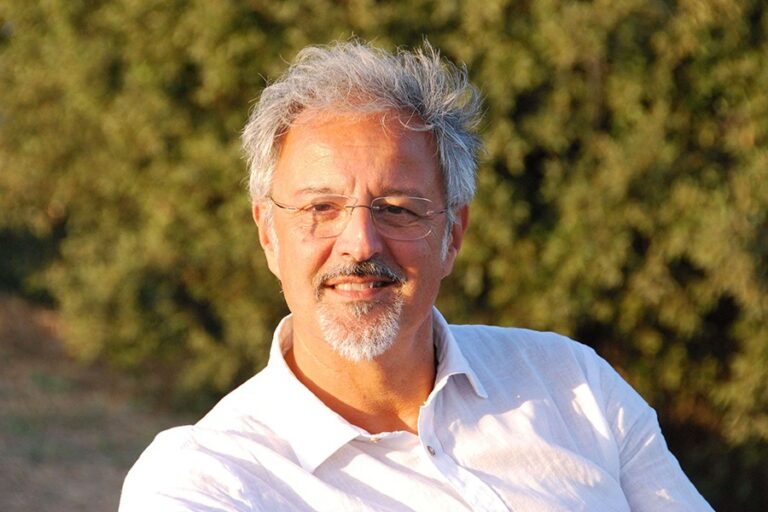 The European Commission published the final version of the Code of Practice on Marking and Labelling of AI-Generated Content on 10 June 2026, as provided for by Article 50 of the AI Act.
The document represents the outcome of eight months of work, including dozens of meetings, workshops, and bilateral discussions involving more than 200 stakeholders and representatives of all 27 European Union Member States.
Two working groups, composed of experts in technology, law, and the social sciences, contributed to defining a framework aimed at preventing deception and manipulation associated with synthetic content and at strengthening public trust in the digital ecosystem.
Professor Dino Pedreschi served as Vice-Chair of Working Group 1, Transparency Obligations Applicable to Providers of Generative AI Systems, which was responsible for developing guidelines on transparency and the identification of content generated by generative artificial intelligence systems. He was supported in this work by Virginia Morini, a postdoctoral researcher at the Department of Computer Science, and Daniele Gambetta, a PhD Student in AI.
“Coordinating this work was both a challenging and fascinating experience. We now hope that many stakeholders will adopt the Code and that it will provide an effective contribution to the fight against misinformation and disinformation by making the human or artificial origin of online content increasingly recognizable. An important aspect is that this work has already inspired similar legislative initiatives in several parts of the world, particularly in California, where we are collaborating with local lawmakers,” said Dino Pedreschi.
Professor Pedreschi also noted that, on 11 June, OpenAI announced its support for the initiative, describing it as a useful instrument for fostering an innovative and trustworthy European AI ecosystem.
Further information is available through the official communication channels of the European Union.
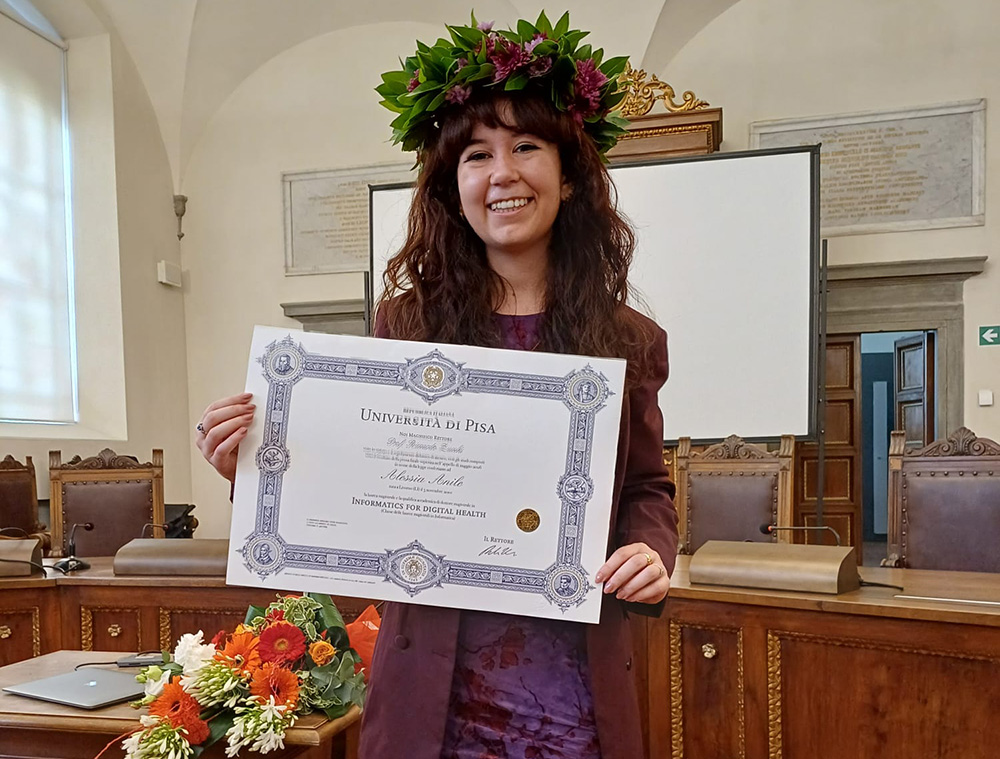 Alessia Anile is the first student to graduate from the University of Pisa’s Master’s Degree Programme in Informatics for Digital Health, an international programme dedicated to the integration of advanced computer science and digital health.
Born in Livorno and 24 years old, Alessia earned her Bachelor’s Degree in Computer Science from the University of Pisa in 2023, after graduating as an IT technician from the “Galileo Galilei” Technical Institute in Livorno. During her master’s studies, she developed interdisciplinary expertise spanning computer science, biology, and medicine, with a particular focus on the increasingly important role of digital technologies in healthcare and clinical research.
Recently established and chaired by Professor Giuseppe Prencipe, the Master’s Degree Programme in Informatics for Digital Health prepares professionals capable of combining advanced computing skills with the needs of digital healthcare, equipping them to address emerging challenges in medicine and biomedical research.
On December 6, the “Unipi CTF” has taken place — a cybersecurity competition for high-school and university students (in room PN10 at the Polo Porta Nuova, from 2:00 p.m. to 7:00 p.m).
Cryptography, web security, low-level challenges, and reverse engineering: participants will tackle a series of tasks to score as many points as possible. In the end, the top three teams will reach the podium and receive a prize.
The event is organized by fibonhack, a group of students, researchers, and cybersecurity professionals, in collaboration with the Department of Computer Science and the Google Developer Group di Pisa.
More details on
E-mail: info@fibonhack.it
 Andrea Cossu received in Rome, at the CNR, the Special Mention of the “Premio Giovani Ricercatrici e Ricercatori” awarded by the Gruppo 2003, of which Professor Ugo Montanari is a founding member.
The awarded work, “Continual pre-training mitigates forgetting in language and vision” (published in Neural Networks in 2024), lies in the area of Continual Learning, which aims to develop artificial intelligence agents capable of learning over time while progressively adapting to new tasks and environments.
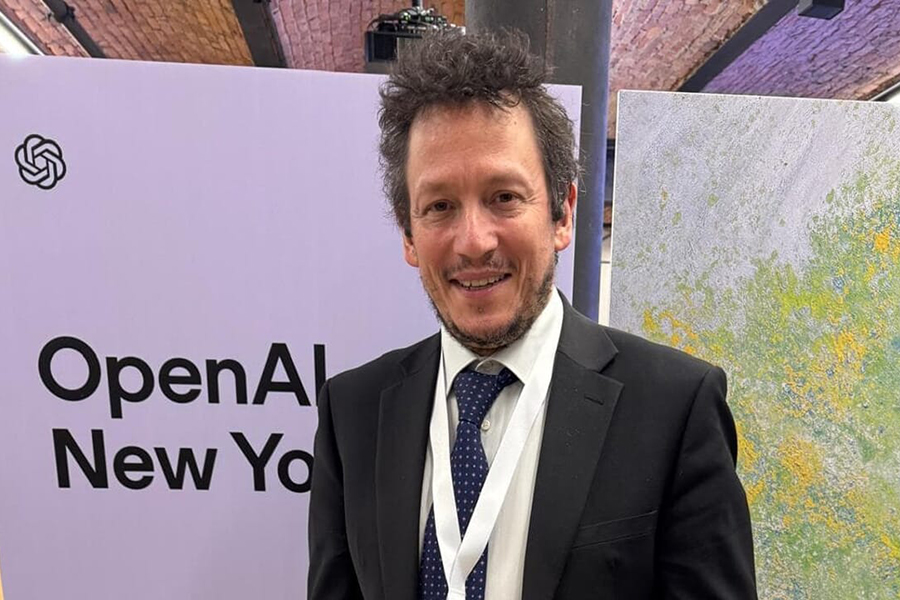
Antonio Cisternino, our professor and president of the Information System at the University of Pisa, is the only Italian among the 300 professors chosen by OpenAI Academy, a free educational platform launched by OpenAI to facilitate the adoption of artificial intelligence in various sectors.
OpenAI has just published a video in which Cisternino talks about how he successfully used ChatGPT in the ICT Infrastructure course of the Master’s Degree in Computer Science.
The excellent feedback prompted the lecturer, together with Professor Andrea Corradini, to take an innovative approach to designing the new edition of the Advanced Programming course, also for the Master’s Degree in Computer Science, focusing on Artificial Intelligence.
The video presents the fundamental ideas behind this new teaching approach, which is not limited to introducing a new tool, but demonstrates the desire and ability to test the technologies that are changing the world.
Technological innovations are often met with scepticism. In this case, a constructive and informed approach was preferred, which is particularly important in programming, where AI is set to profoundly transform the future landscape.
The European Commission published the final version of the Code of Practice on Marking and Labelling of AI-Generated Content on… Alessia Anile is the first student to graduate from the University of Pisa’s Master’s Degree Programme in Informatics for Digital… On December 6, the “Unipi CTF” will take place — a cybersecurity competition for high-school and university students. The event… From November 21 to 24, Pisa celebrates Leonardo Fibonacci, the mathematician who introduced Arabic numerals to Europe. The event coincides… The second edition of the Quantum Festival, dedicated to quantum computing, is about to begin, with the theme #SguardiAlFuturo (Looking… On 5 November, the European Commission’s AI Office began drafting the Code of Practice on marking and labelling of… The Italian team, led by our master’s student Lorenzo Leonardini, won first place at the European Cybersecurity Challenge (ECSC 2025),… Dino Pedreschi, our professor and pioneer of data science in Europe, is one of the signatories promoting Red Lines on… Stefano Forti, a researcher in the Department, took the podium at the Logic Programming / Constraint Programming Contest (LP/CP 2025)… During the ICANN 2025 conference, held in Kaunas (Lithuania), Alessio Micheli was elected President of the European Neural Network Society… On Friday 26th, and in the days leading up to it, Bright – La Notte delle Ricercatrici e dei Ricercatori… Lorenzo Leonardini, a master’s student in our Department, will be the captain of Team Italy at the European Cybersecurity Challenge… Antonio Cisternino, our professor and president of the Information System at the University of Pisa, is the only Italian among… Secondo titolo italiano per la squadra pisana, premiata anche per il miglior attacco e la migliore presentazione Pisa, 15 luglio… Il Dipartimento di Informatica dell’Università di Pisa offre il primo corso di perfezionamento in “AI 4 Health Innovation” pensato per… La Commissione Europea ha pubblicato il 10 giugno 2026 la versione definitiva del Code of Practice on Marking and Labelling… Alessia Anile è la prima studentessa a conseguire il titolo nel corso di laurea magistrale in Informatics for Digital Health…EU AI Office Names Dino Pedreschi Vice-Chair of Working Group 1 for the AI Act Code of Practice
First student to graduate in Digital Health
Unipi CTF: Cybersecurity challenge at the University of Pisa
Fibonacci Days 2025
Quantum Festival 2025
EU AI Office Names Dino Pedreschi Vice-Chair of Working Group 1 for AI Act Code of Practice
First place for the Italian team led by Pisa at the European Cybersecurity Challenge 2025
United Nations, global appeal for limits on AI: Dino Pedreschi among the promoters
Another podium finish for UniPI at the international Logic Programming contest
Alessio Micheli, new president of the European Neural Network Society
Computer Science Department: Bright Night
Lorenzo Leonardini, a master’s student in our Department, will be the captain of Team Italy at the European Cybersecurity Challenge
Looking for a smart way to use Artificial Intelligence in teaching
CyberChallenge.IT 2026: l’Università di Pisa vince la finale nazionale
Corso di perfezionamento in AI 4 Health Innovation
Pubblicato il Code of Practice europeo sui contenuti generati dall’IA: il contributo del professor Dino Pedreschi
Prima laureata magistrale in Digital Health